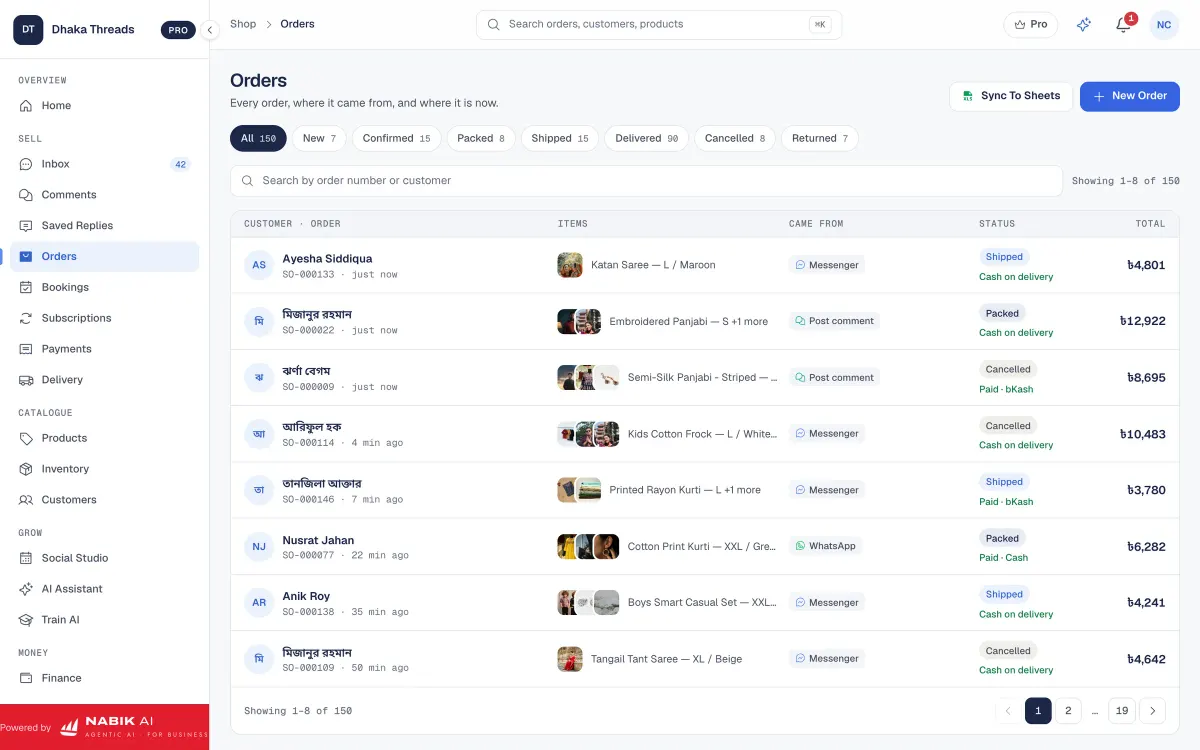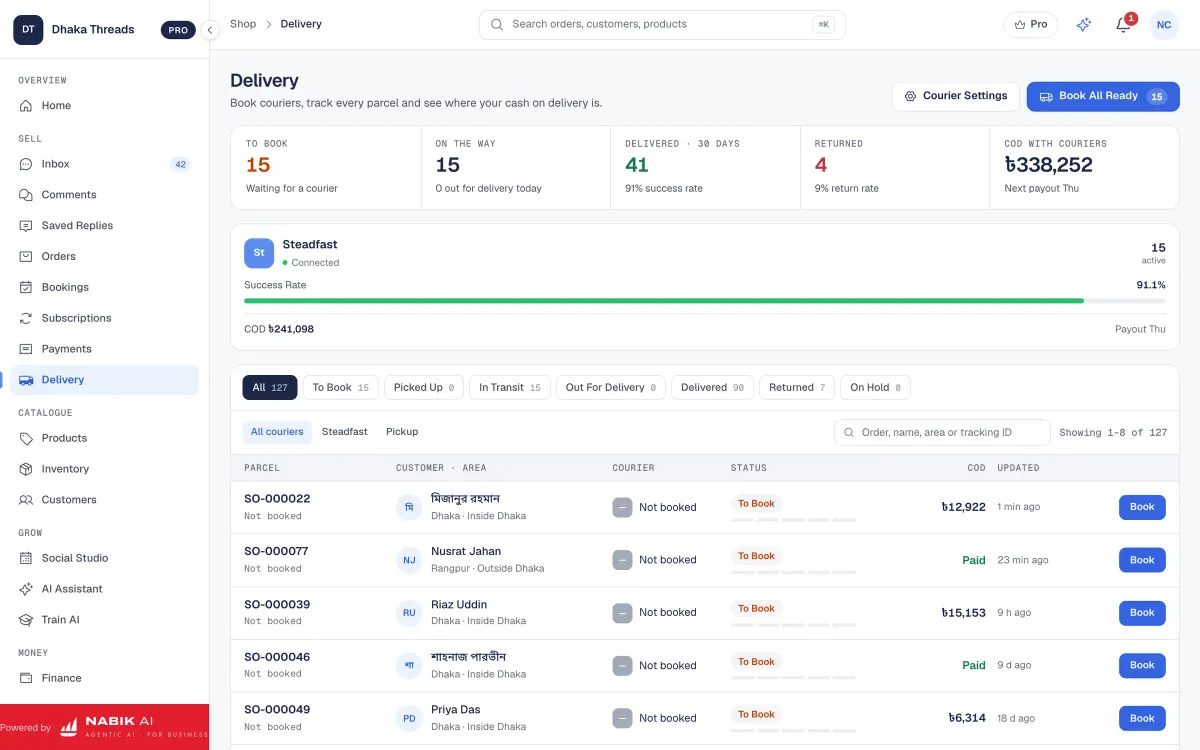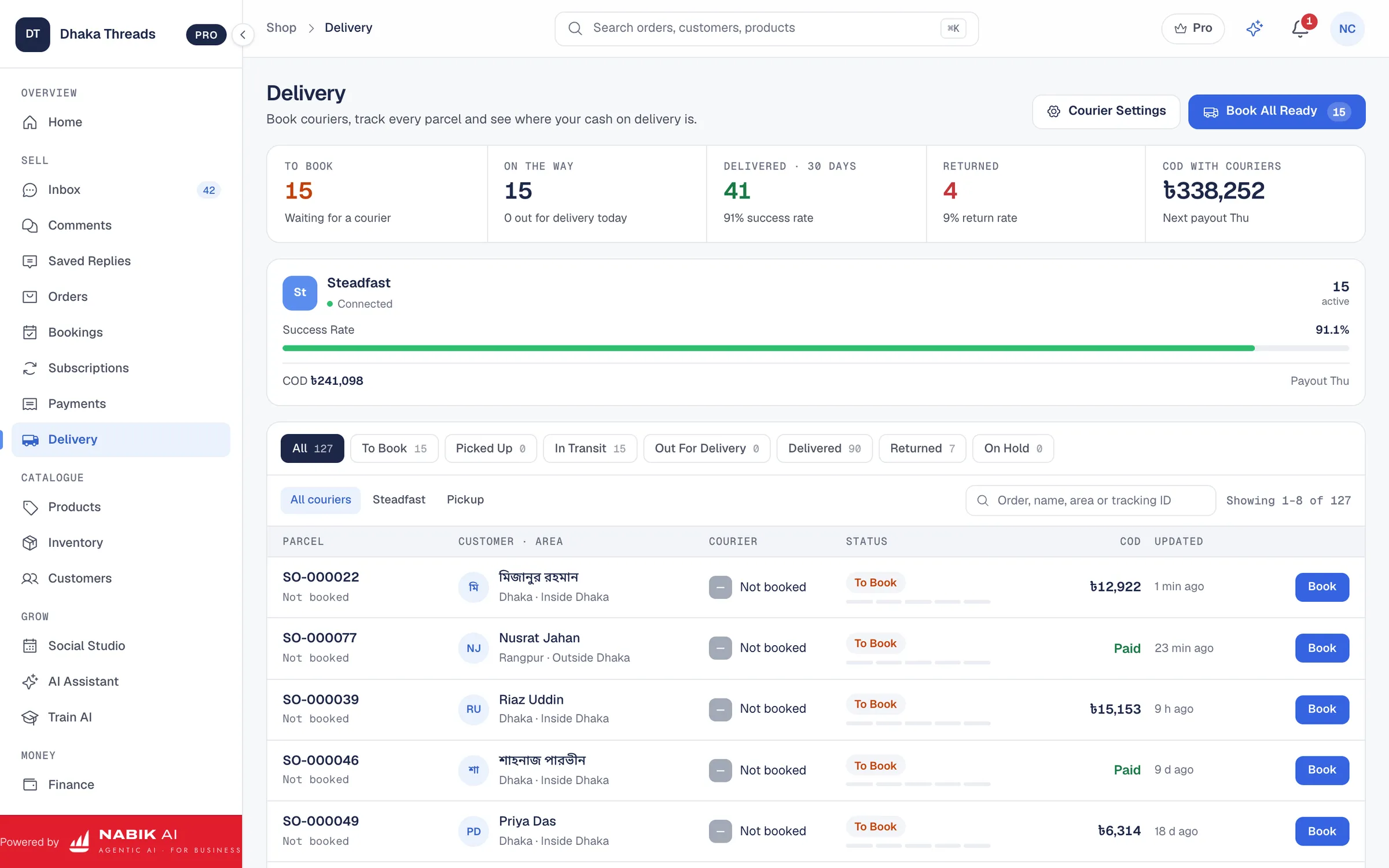
RTO rate in Bangladesh is the percentage of your parcels that couriers return to you instead of delivering to customers. A high RTO rate quietly kills the profit of Facebook, Instagram and WhatsApp shops, especially with cash on delivery.
This guide explains what RTO (Return To Origin) really means, how much refused parcels cost you, and what you can do this week to bring your RTO rate down. All examples and tips are written for Bangladeshi shops using local couriers, COD, bKash and Nagad.
Key Takeaways
- RTO rate shows what portion of your shipped orders come back undelivered, and it should be watched like a key business number.
- Refused COD parcels cost more than just courier fees; they waste ad spend, time and stock and hurt cash flow.
- You can reduce RTO rate in Bangladesh with clearer product info, better confirmation, faster dispatch and smarter courier choices.
- Tracking RTO by courier, area and campaign lets you find the real leaks instead of just blaming customers.
- Nabik AI helps Bangladeshi shops manage COD orders, couriers and stock so RTO rates stay under control.
What Is RTO Rate For Bangladeshi Online Shops?
RTO means Return To Origin: the courier tried to deliver your parcel but could not, so it comes back to you. Your RTO rate is the percentage of parcels you shipped in a period that returned instead of delivering.
For a Bangladeshi F-commerce shop, RTO usually happens with cash on delivery (COD) orders. Common reasons: customer changed mind, did not pick calls, said “order dei nai”, or the address/phone was wrong. Sometimes the courier also fails to call properly or visit on time, and the customer refuses out of frustration.
You do not need any fancy tool to understand your own RTO rate. Take one month, count how many parcels you handed to couriers, and how many of those came back. Once you see the number as a percentage, you will understand if RTO is just a small headache or a serious problem.
Use this simple formula on paper or Excel: - RTO rate (%) = (Number of returned parcels ÷ Number of parcels handed over to courier) × 100 If you sent 300 parcels and 60 came back, your RTO rate is (60 ÷ 300) × 100 = 20%. From there, your job is to push that number down month by month.
- List every parcel you shipped last month by hand or from your courier panel.
- Count how many of those show as "Returned", "RTO" or "Refused".
- Use the formula and write your RTO rate on a whiteboard or in a notebook where you can see it every day.
Step 1: Collect Last Month’s Courier Data
Download CSV/Excel from your courier, or at least note total parcels shipped and parcels returned.
Step 2: Calculate Your RTO Rate
Use a calculator or Excel to divide returned parcels by total shipped, then multiply by 100.
Step 3: Decide A Target To Improve
Write down a realistic target to reduce your RTO rate over the next 1–3 months.
How Do You Calculate And Track Your RTO Rate Properly?
Knowing your RTO rate once is not enough; you have to track it regularly and break it down. One overall number hides which courier, area, campaign or product is causing trouble. Simple tracking will show you if the problem is your ad audience, your size chart, a specific courier, or something else.
Start by separating your RTO counts by: - Area: Dhaka vs outside Dhaka; and if possible, by city or thana. - Courier: Different couriers have very different success rates in different districts. - Source: Organic Page, boosted post, TikTok, influencer, WhatsApp group, etc. - Product type: Clothing vs cosmetics vs electronics, and specific risky SKUs.
You can do this with a basic Google Sheet or Excel. Create columns: Date, Order ID, Product, Area, Courier, Order Source, Status (Delivered/Returned), Reason. Every time a parcel is returned, fill in the reason like “wrong size”, “customer changed mind”, “didn’t answer phone”, “late delivery”.
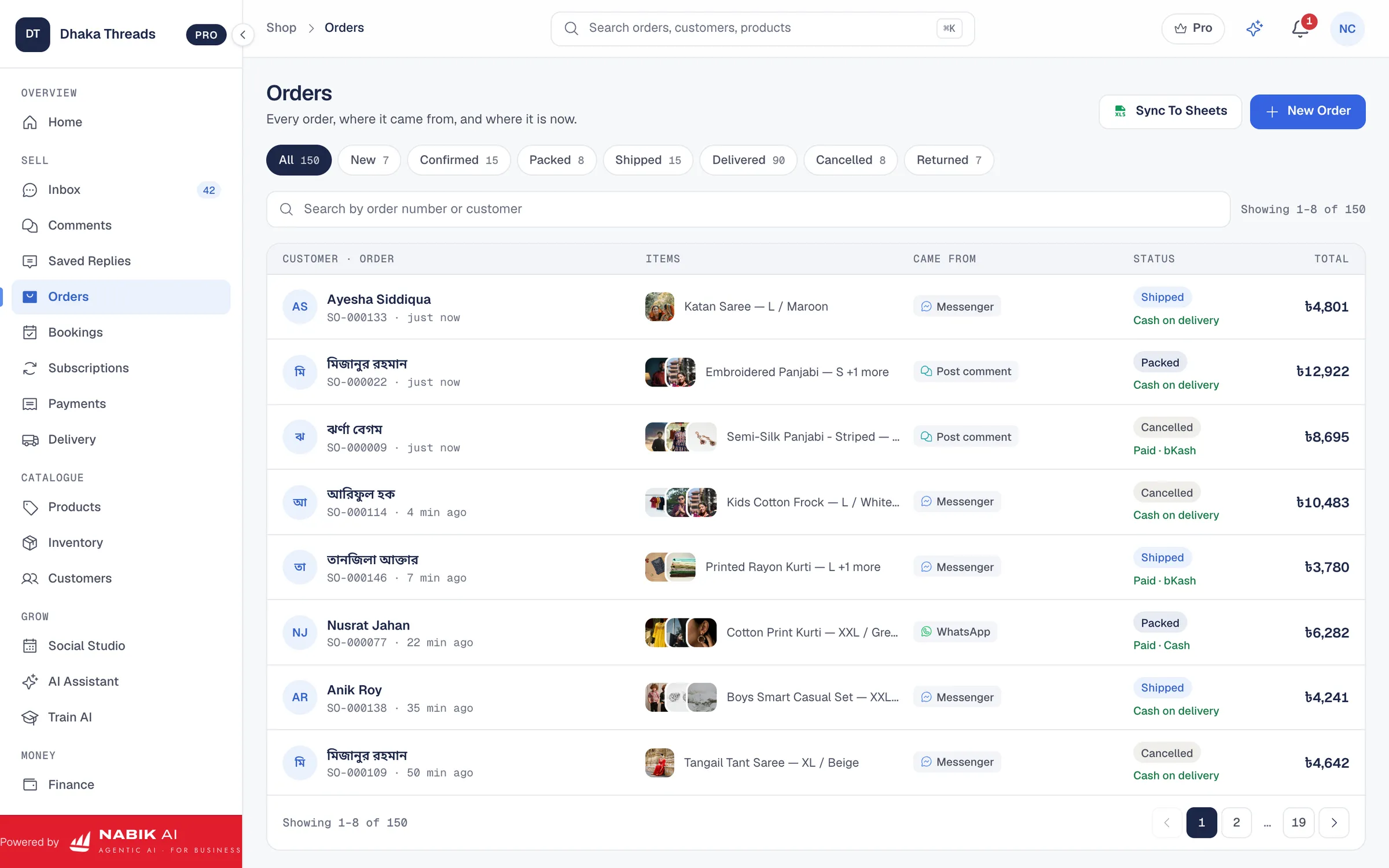
If you use software like the order management and courier integration tools in Nabik AI, a lot of this tracking is done automatically from your chat orders and courier updates. Even if you stay on Excel, set a fixed weekly time (for example, Saturday night) to update your RTO sheet and look at the pattern. Consistency is more important than perfection.
- Create one master sheet for all orders, not separate for every Page or channel.
- Give every order a clear status: Pending, Shipped, Delivered, Returned.
- Always write a reason when an order returns, even if it feels obvious.
Step 1: Set Up Your RTO Tracking Sheet
Make columns for date, order ID, area, courier, product, order source, status and RTO reason.
Step 2: Update Once A Week
Block 30–60 minutes every week to update statuses and reasons from your courier panel or notebook.
Step 3: Review By Category
Filter your sheet by courier, area or product to spot where RTO is highest.

What Do Refused Parcels Really Cost Your Shop?
Many Bangladeshi shop owners think RTO only means “lost delivery charge”. In reality, a refused parcel burns money four or five different ways: courier charge (both ways), packaging, ad cost, staff time, and stuck stock. Understanding this full cost helps you see why a 15–30% RTO rate is dangerous, even if profit per item looks high on paper.
Let’s break down a typical COD order of, say, a dress you sell for ৳1,500. You spend money on boosting the post, staff to reply inbox, packaging, and courier charges. If the customer accepts, all of that is covered by the profit. If the customer refuses, almost all of that becomes a pure loss in this week’s cash flow.
Use the table below as a simple model. Numbers are illustrative only; you can put your own amounts in the same structure to see the damage clearly. The important point: an RTO parcel eats not just today’s profit, but also your ad budget and the energy of your small team.
Once you see this clearly, you will stop saying “RTO toh sobar hoy” and start treating it like a real business problem. That mindset shift alone will make you more strict about confirmation, courier choices and risky customers.
- List all costs that touch an order: ad spend, packaging, staff salary time, courier fees.
- Estimate an average for each cost per parcel, not just per day.
- Use those averages to see how much one refused parcel really costs you in taka.
| Delivered COD Order | Returned (RTO) Order | Fake / Wrong Order | |
|---|---|---|---|
| Cash Flow This Week | You receive full COD amount from courier, minus their charge. | You pay courier charges, but receive no sales money this week. | You pay courier charges, receive no money and waste even more time. |
| Courier Cost You Pay | One-way charge (shop → customer). | Often both ways (shop → customer → shop) or a penalty. | Both ways or penalty, plus maybe extra handling fees. |
| Stock Position | Item is sold, you can reorder if needed. | Item comes back later; stock is blocked during the whole trip. | Same as RTO, but often damaged packaging or missing accessories. |
| Hidden Costs | Ad spend and inbox time are covered by profit. | Ad spend, packaging and staff time become a loss. | Higher risk score for area/courier; more stress for your team. |
Why Is Your RTO Rate High In Bangladesh?
In Bangladesh, high RTO is not just about “bad customers”. It is a mix of buyer behaviour, COD culture, courier realities and how clearly you present your product. If you blame only customers, you will miss the parts you can control.
Common reasons your RTO rate may be high: - Weak confirmation: no proper confirmation call or inbox confirmation for COD orders. - Confusing product info: free-size dresses, no size chart, heavy filters, misleading lighting. - Delivery delay: parcel reaches after 4–7 days; customer bought from someone else or lost interest. - Courier issues: rider not calling, rude behaviour, wrong area selection in AWB. - Customer type: very young buyers, “just browsing”, or people ordering as a joke.
Some issues are under your control right away. You can improve your product descriptions, share clear real photos, and confirm orders better. You can change courier for specific areas and keep a blacklist of repeat fake customers. For outside Dhaka, you can clearly tell customers, “Delivery 3–5 din, please keep phone on,” before booking.
Other factors are harder to change, like general COD habit (“ashle nebo, na ashle nai”) and weak address systems in many areas. Still, your job is to design your ads, chat scripts and courier setup in a way that reduces these risks step by step.
- Review your last 20 RTO orders and mark which ones were avoidable by better confirmation or clearer info.
- Check if RTO is worse for specific kinds of posts (for example heavy offers or very edited photos).
- Ask your courier manager honestly which areas usually have more refusals and if their riders really call customers.
Step 1: Audit Recent RTO Orders
Print or list your last 20–30 RTOs and write the main reason beside each one.
Step 2: Group By Cause
Mark causes you can control (info, confirmation, courier choice) vs things you cannot fully control.
Step 3: Pick 2–3 Controllable Fixes
Choose a few concrete changes (e.g. new size chart, different courier for a district) to test next week.
How Can You Reduce Your RTO Rate Day To Day?
Lowering RTO in Bangladesh is about many small habits, not one magic trick. Focus on the journey: from seeing your post to parcel in hand. At each step, ask, “How can I reduce confusion and make it easier to say yes at the door?”
Start with clearer product information in posts and DMs. Use real photos (indoor + outdoor if possible), simple size charts in Bangla, and honest notes like “fabric slightly see-through, need inner” instead of hiding it. A customer who knows exactly what they are getting is much less likely to refuse. For fashion, mention length, body fit and stretchiness; for electronics, mention warranty and return policy clearly.
Next, improve order confirmation. For COD orders, always: repeat product, size, colour, price, delivery charge and approximate delivery time. You can send a short message: “Apnar order: XL black kameez, ৳1,650 + ৳80 delivery, total ৳1,730. Dhaka 1–2 din, outside 3–5 din. Confrim korben?” If the customer does not confirm clearly, do not book the parcel.
Finally, fix logistics basics. Dispatch parcels same or next working day; slow dispatch increases mind-change. Use a more reliable courier for districts where RTO is high; our guide on choosing a courier service in Bangladesh can help you structure this. For very high-risk areas or repeat offenders, you can ask for small bKash or Nagad advance payment using payment links or reduce heavy “free delivery” offers there.
- Add one honest “Who should not buy this” line in your captions to filter weak buyers.
- Use a standard confirmation script so every staff member repeats the same key details.
- Separate high-risk orders (new customer, expensive item, far district) for extra checking before booking courier.
Step 1: Update Your Product Templates
Rewrite 3–5 top-selling product descriptions today with clear size, fabric and return details.
Step 2: Create A Confirmation Checklist
Write a 5-point checklist (item, size, price, delivery charge, ETA) and keep it near every agent’s desk.
Step 3: Tweak Courier Rules
Decide which courier to use for which areas based on your past RTO data, not just lowest price.
How Should You Handle RTO Parcels When They Come Back?
Your work does not end when a parcel returns; how you handle RTOs decides how much money you can recover. Many small shops just throw refused parcels in a corner and feel bad. Instead, you need a small, repeatable RTO SOP (Standard Operating Procedure).
When a parcel comes back, first log it properly. Update its status to Returned in your sheet or order system, with the reason. Check the product condition: packaging, tags, any stains or damage. Decide if it can be sold as new, needs repacking, or should be sold at a discount in a “stock clearance” offer.
Next, deal with the customer. If the reason was genuine (late delivery, you or courier at fault), apologise and see if they still want the product with a small gesture (for example free delivery next time). If the customer clearly faked the order, mark them in a blacklist sheet so you do not accept COD again from that number or address.
Finally, look at RTOs as data, not just pain. Every refused parcel tells you something about product fit, courier, price or your promises in comments and DMs. Review RTOs once a week for patterns, and use that insight in your next campaign or stock purchase.
- Keep a separate “RTO shelf” in your stock room, with labels for New, Repack, Discount.
- Mark repeat fake customers clearly with phone + address so new staff can recognise them.
- Try to resell good-condition RTO items quickly with a small offer instead of letting them age in storage.
Step 1: Create An RTO Shelf
Physically separate returned products in your inventory area and label them by condition.
Step 2: Update Order Statuses
Every time a parcel returns, update its status and reason in your sheet or software the same day.
Step 3: Run A Monthly RTO Review
Sit with your team and scan all RTOs of the month to learn what needs to change in sales or logistics.
How Can Nabik AI Help With RTO And COD Returns?
Most RTO problems start in the inbox, long before the parcel reaches the customer’s door. Nabik AI is web software made in Bangladesh that helps shops who sell on Facebook, Instagram, WhatsApp and their own websites manage chats, orders and couriers in one place. Its AI agents answer in Bangla, Banglish or English from your own products, prices and policies, then take orders and hand over to you when needed.
Because conversations, orders and couriers live together, it becomes much easier to control RTO. From one social inbox, your team can see all Messenger, WhatsApp, Instagram and Page comments. The AI can repeat key details (item, size, price, delivery, ETA) consistently in every chat, reducing misunderstandings that later become refused parcels. If you correct it, it learns from that correction for next time, so your confirmation quality improves over time instead of getting worse on busy days.
Once an order is confirmed in chat, it goes into Nabik AI’s order management screen with cash on delivery details and status. From there, you can use courier integration to book parcels and track which ones delivered or returned. Returned parcels update the order status, so you can quickly see RTO by area or courier without digging through multiple panels.
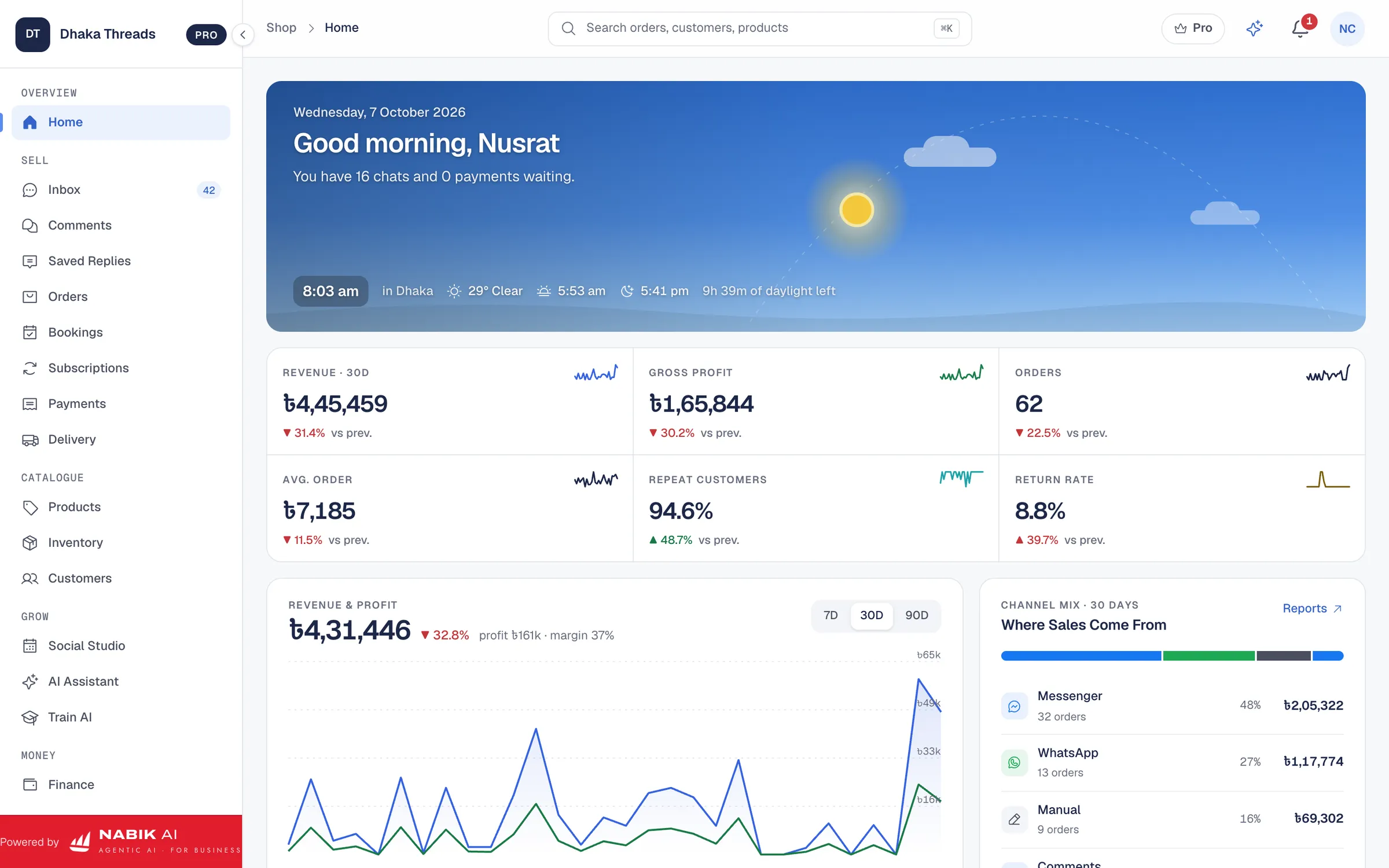
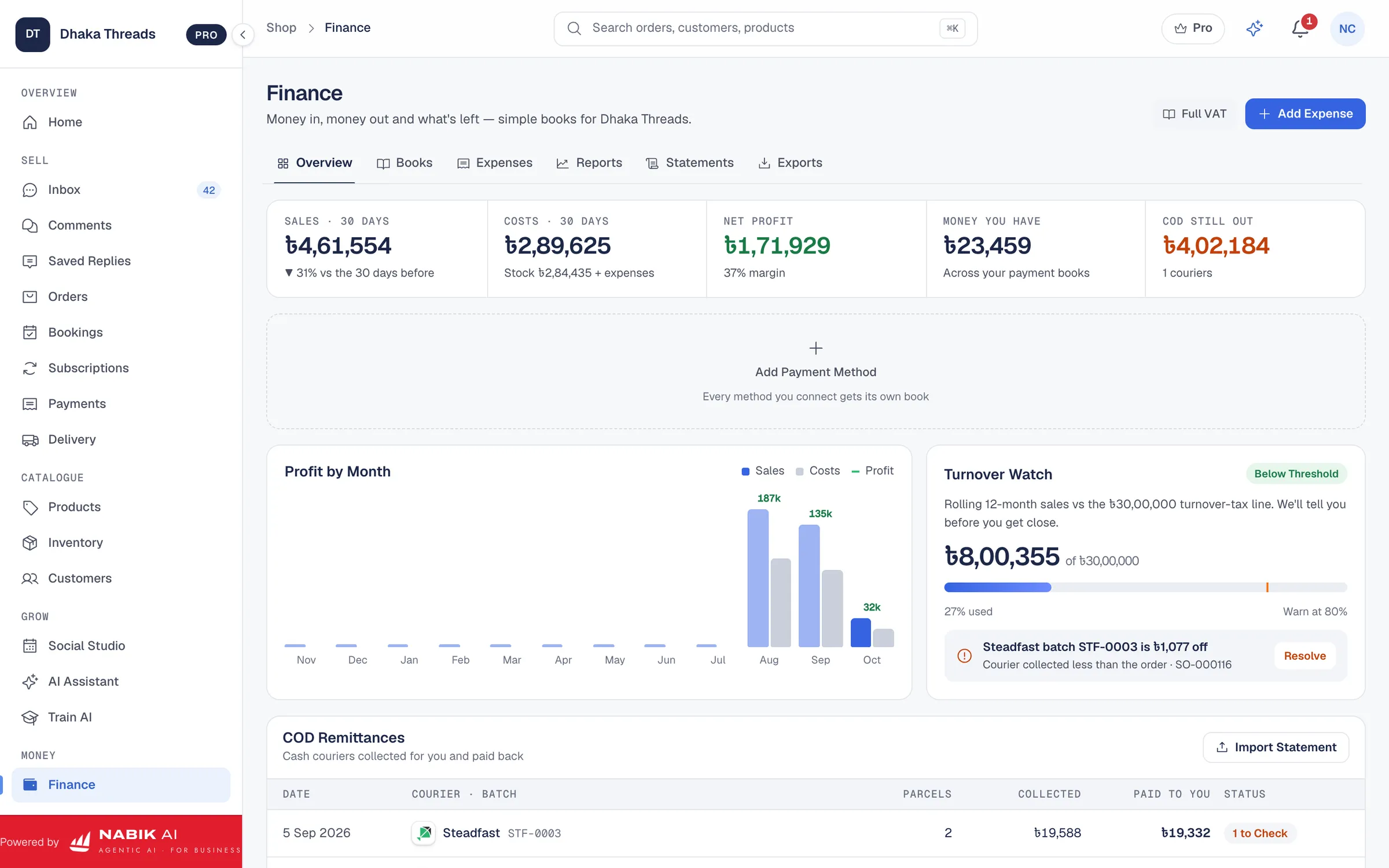
Because stock, orders and finance sit together in Nabik AI’s inventory management and accounting & VAT tools, you can see how much value is stuck in RTO at any time. Plans start free at app.nabik.ai, with Pro at ৳999/month and Business at ৳3,780/month, and AI usage is based on AI credits. If you are serious about cutting RTO, automating repeat questions and having one view of chats, orders and returns will save both time and money.
- Use AI answers in Bangla/Banglish to explain sizes, fabric and delivery clearly before the customer orders.
- Confirm all COD orders from one place instead of jumping between apps and screenshots.
- Watch RTO data by courier and area so you can change your logistics rules quickly.
Step 1: Start A Free Nabik AI Workspace
Go to https://app.nabik.ai/signup and connect your Facebook, Instagram or WhatsApp channels.
Step 2: Teach The AI Your Policies
Chat with the AI about your delivery times, return rules and size charts so it can answer correctly.
Step 3: Monitor RTO In Orders Screen
Use the orders and courier screens weekly to see which areas and couriers are causing most returns.
FAQ
What is RTO meaning in courier for Bangladesh?
In Bangladesh, RTO in courier language means Return To Origin. It is used when a parcel could not be delivered to the customer for any reason and is sent back to the sender shop. For an online shop, a high RTO rate means many of your shipped parcels are coming back instead of bringing you cash.
What is a good RTO rate for a Bangladeshi online shop?
There is no single “right” RTO rate because it depends on product type, price and target customer. But for most small shops, the goal is to keep RTO low enough that your profit after courier and ad costs is still healthy. The important thing is to measure it monthly and work to reduce it, not to accept a high RTO rate as normal.
How can I reduce fake COD orders in Bangladesh?
You can reduce fake COD orders by using clearer product photos and descriptions, strict confirmation (inbox or call), and better filtering in your ads. For risky areas or repeat offenders, consider small bKash or Nagad advance payments before booking the parcel. Our detailed guide on reducing fake COD orders gives more step-by-step ideas.
Does changing courier help to lower RTO rate in Bangladesh?
Yes, sometimes a different courier with better delivery in specific districts can lower your RTO rate. Some couriers are stronger in Dhaka, others in certain towns or rural areas. Track RTO by courier and area, and switch based on your own data instead of only looking at lowest delivery price.
Should I stop offering cash on delivery to reduce RTO?
In Bangladesh, fully removing COD usually cuts your order volume sharply, because many customers still prefer COD. A more balanced approach is to keep COD but add advance payment for high-risk orders, or give small incentives for prepayment. Over time, you can slowly increase prepaid share while still serving COD customers carefully.