If you sell on Facebook, Instagram or WhatsApp, ecommerce software in Bangladesh usually matters more for you than a fancy website builder. Most Bangladeshi shops first need help with messages, cash on delivery orders, couriers and stock; a website can come later or connect on top.
A website builder mainly gives you a nice online shop website. Ecommerce software gives you the back office: orders, inventory, delivery, payments and customer records for all your channels. This guide explains the difference in simple language, with examples from Dhaka and outside Dhaka, so you can choose what to pay for now and what to delay.
By the end you will know whether to start with ecommerce software, a website builder, or both, and how tools like Nabik AI can fit into your plan. You will also get a 30‑day action checklist you can follow even if you run the business alone from your phone.
Key Takeaways
- Most Bangladeshi shops should invest in ecommerce software before a website builder, because most sales come from chats, comments and cash on delivery.
- Website builders are useful for branding and trust, but they do not fix problems with Messenger replies, courier booking or stock control by themselves.
- The right setup for many F‑commerce shops is: Facebook/WhatsApp + ecommerce software now, then add a website later and connect it to the same stock and orders.
- Nabik AI works as ecommerce software made for Bangladeshi social sellers, with AI chat, one inbox, orders, inventory and website integrations.
- You can decide confidently in 30 days by mapping your current mess, testing software on real orders and only then spending on a website if it still makes sense.
What Problem Are You Actually Trying To Solve?
Before choosing ecommerce software or a website builder, be clear about your real problem. For most Bangladeshi shops, the issue is not "I do not have a website" but "I cannot handle all these messages and orders". Customers are already messaging: “Apu, last pic er dress stock ase?”, “Outside Dhaka delivery koto?”. If you cannot reply fast, track payments and send parcels on time, a beautiful website will not save you.
List the painful situations you face in a normal week. Maybe you lose orders in Messenger because you also check WhatsApp and Instagram. Maybe you forget which bKash payment came from which customer. Maybe the courier loses parcels and you do not know which ones were delivered or returned. These are operations problems, not website design problems.
Once you see this clearly, your decision becomes easier. Tools that improve your daily work (inbox, orders, stock, courier, VAT) are ecommerce software. Tools that improve how you look on the internet (templates, themes, sliders, homepage) are website builders. You probably need both one day, but not on the same day.
So the first step is simple: write on paper your top three headaches. For example: 1) late replies, 2) missing orders, 3) wrong product or size sent. Keep that list in front of you while reading the rest of this guide and check which option fixes which problem.
- Write down your three biggest online selling problems today.
- Mark each problem as messages, orders, stock, delivery, payment or image/branding.
- Decide if your main pain is how you look (branding) or how you work (operations).
What Is Ecommerce Software For A Bangladeshi Shop?
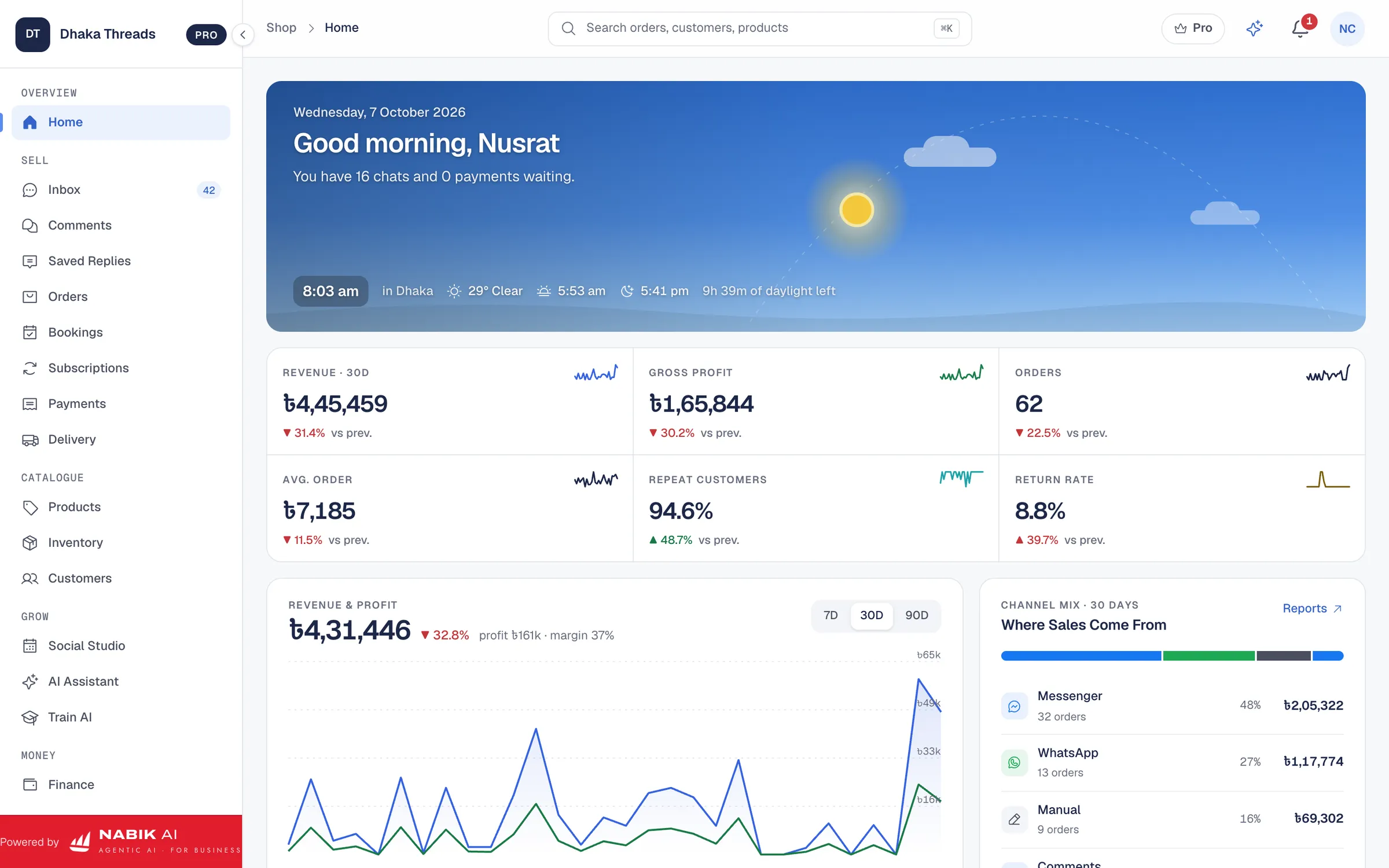
Ecommerce software is the system that runs your online shop behind the scenes. For a Bangladeshi F‑commerce seller, that means one place to see messages, confirm orders, track cash on delivery, manage stock and book couriers. Instead of using separate notebooks, Excel and random screenshots, you use one app that knows each customer and each parcel. It does not have to replace Facebook or WhatsApp; it works around them.
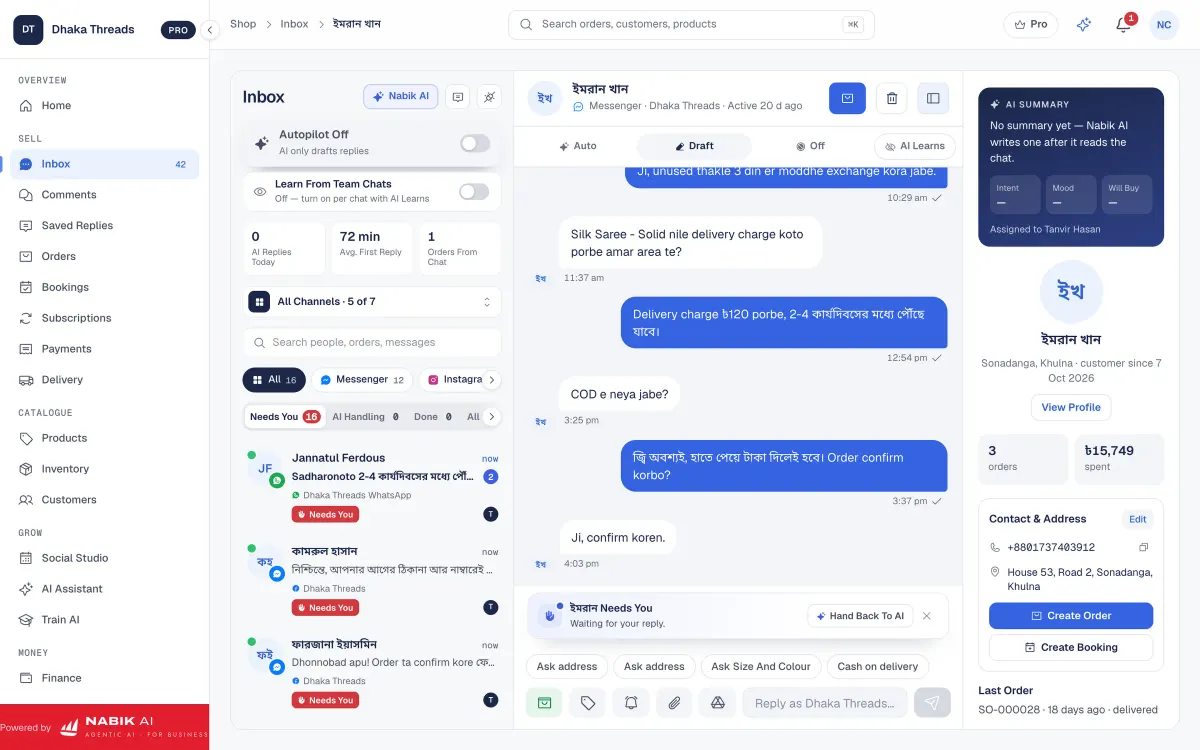
Modern ecommerce software for Bangladesh usually includes a social inbox, orders, inventory and courier tools. A social inbox puts Facebook Messenger, Instagram, WhatsApp and Page comments into one screen, so you stop jumping between apps; Nabik AI does this with its one inbox for all social channels. Order management lets you create COD orders from chats, update status (confirmed, packed, shipped, delivered, returned) and see totals at the end of the day; see tools like orders with cash on delivery and couriers for what this looks like.
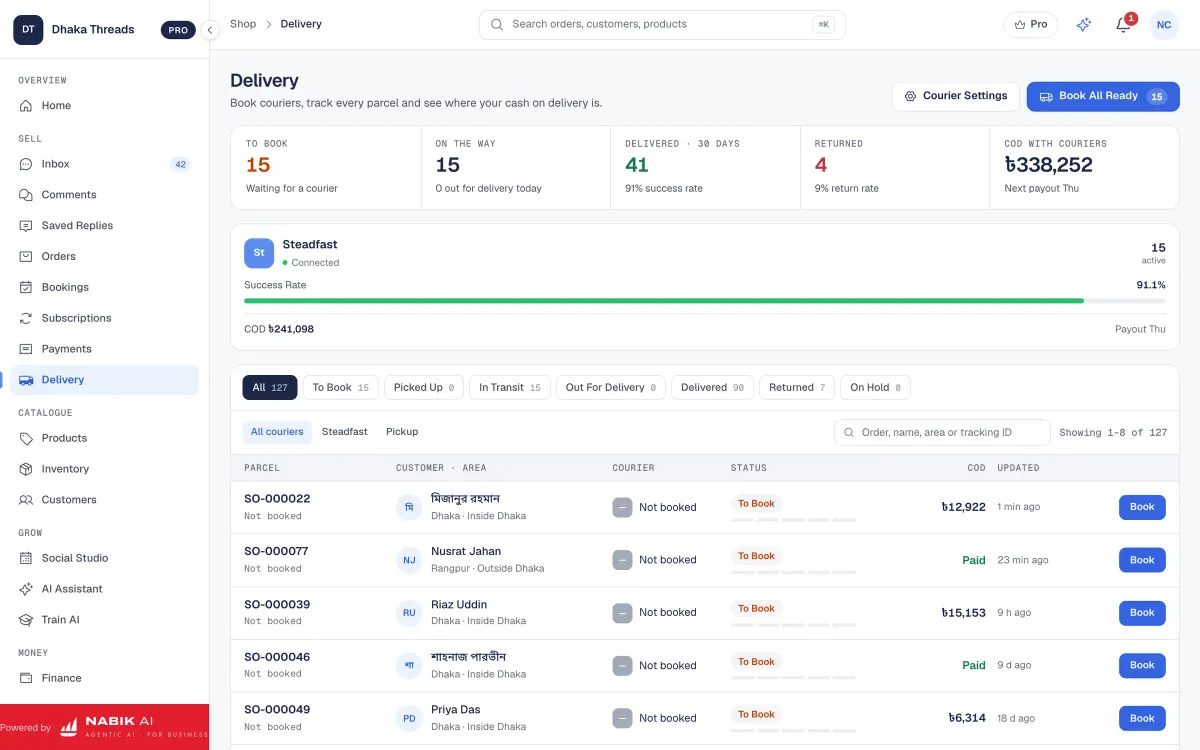
Inventory control is another big piece. Instead of guessing if you still have size 38 in red sandal, ecommerce software reduces stock automatically when you confirm an order. Good systems also show low‑stock alerts so you can re‑order before Eid or Puja rush. Courier integration then lets you book deliveries and print slips for different couriers from the same system, which matters a lot when you send outside Dhaka.
If most of your sales come from chats and COD, ecommerce software should be your first spend. It does not stop you from building a website later. In fact, when you do build one, it is safer to connect it into the same orders and stock instead of starting a second, separate mess.
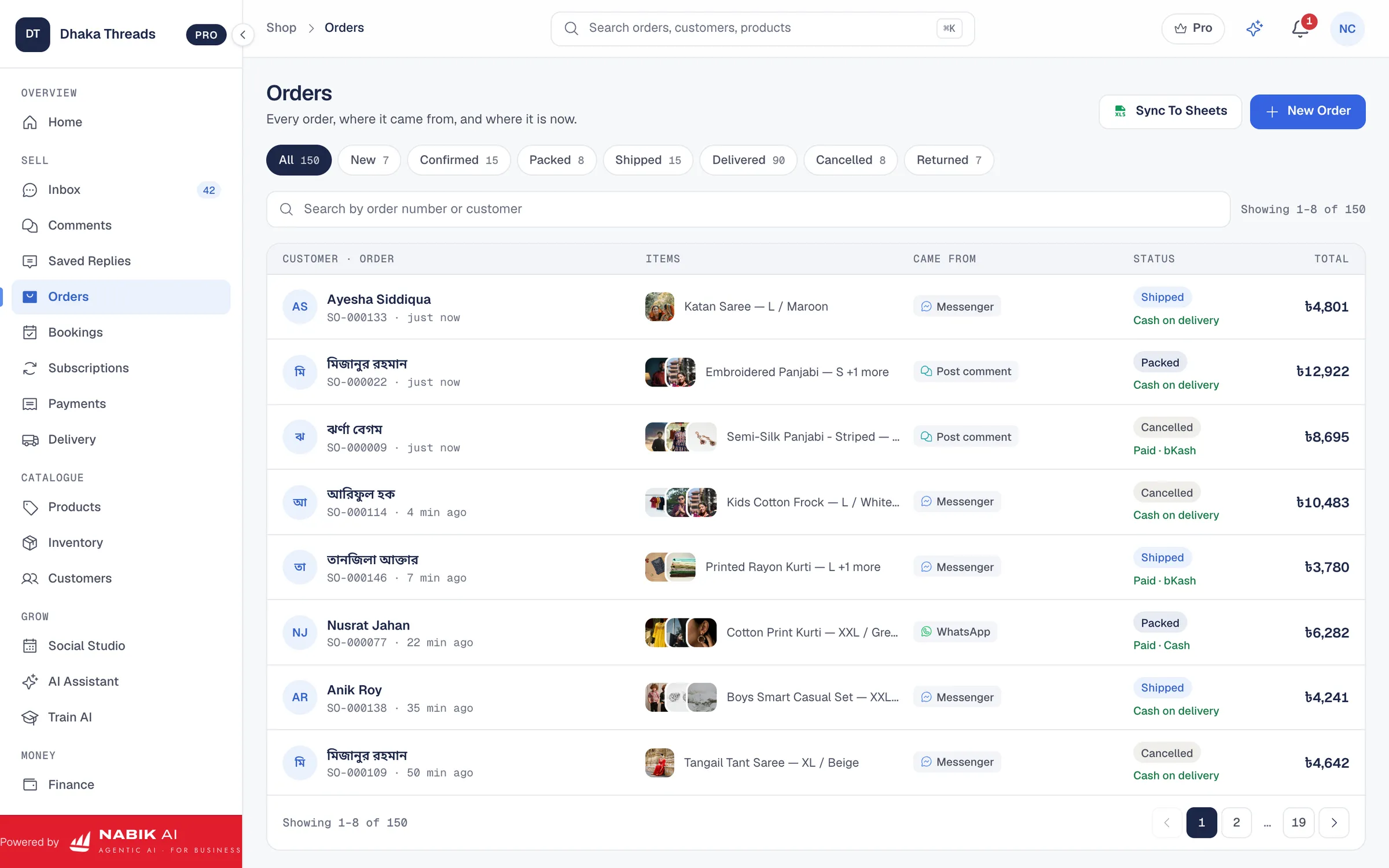
- Centralise messages, orders, stock and courier booking in one app.
- Use social inbox to reply faster without missing any customer.
- Create proper COD orders from chats instead of saving names in Notes.
- Keep one stock count across Facebook, Instagram, WhatsApp and (later) website.

What Is A Website Builder And When Does It Help?
A website builder is a tool that helps you create a website without coding. You choose a template, add your logo, colours and pictures, and the builder makes pages like Home, Shop, About and Contact. Many builders have drag‑and‑drop sections: banner, product grid, reviews, FAQs. You connect a domain (like yourbrand.com) and people can visit your site directly or from Facebook and Google ads.
For a Bangladeshi shop, a website builder mainly helps with branding and trust. Customers feel more confident when they see a proper site instead of only a Facebook Page, especially for higher‑price products like electronics, gold plated jewellery or skincare. A website can also collect orders late at night when you are sleeping and can show all your products nicely in one place. It can help you appear on Google Search over time.
But a website builder by itself does not solve your daily F‑commerce problems. It does not automatically reply to Messenger, manage your courier bookings or handle bKash/Nagad confirmations for COD. If you are already struggling to manage 30–50 messages a day, adding a website on top can make life harder: now you have orders from chats plus orders from your site, and no system joining them. Many Bangladeshi shops experience this and then go back to “Inbox diyei order nin, apu”.
So a website builder is a “front of shop” tool. Use it when your brand is somewhat stable, your operations are under control and you want to look more professional or run serious ads. Do not expect it to magically fix your process problems.
- Use a website builder to look more professional and increase trust.
- Show your full catalogue in one link for ads and Google Search.
- Understand that website orders will add work if you do not have an order system yet.
How Do Ecommerce Software And Website Builders Compare?
To decide where to spend first, compare ecommerce software and website builders side by side. Think about what matters for your shop this month: replying to customers, packing faster, reducing fake COD, or looking more premium online. The table below uses common situations for Bangladeshi F‑commerce sellers so you can see which tool helps where.
Notice how ecommerce software focuses on the back‑end: operations, cash flow, stock and delivery. Website builders focus on the front‑end: design, perception and traffic. Ideally you use both, connected, but most small shops cannot pay for everything from day one. Use this comparison honestly against your current pain list from Section 1.
After reading, mark with a pen which column matches your biggest problem today. That column is usually what you should buy first. You can always add the other column later once cash flow improves.
| Ecommerce Software | Website Builder | |
|---|---|---|
| Main Job | Manage messages, orders, stock, delivery and basic finance | Create a public website that looks good and shows your products |
| Where It Works Best | Facebook, Instagram, WhatsApp, call centre, marketplace orders | Google Search, ad landing pages, direct website visitors |
| Helps With COD | Yes: COD order slips, courier status, returns tracking | Sometimes: basic order form, but courier and COD are separate |
| Impact On Daily Stress | Reduces stress by organising work and showing clear queues | Can increase stress if you add website orders without a system |
| Trust And Branding | Customers do not always see it; impact is indirect | Directly improves how “professional” your business looks |
| Starting Cost | Often low monthly fee; some tools have free plans | Can be cheap, but domain, hosting, SSL and custom design add up |
| Best Time To Add | When you start getting regular chat orders and feel disorganised | When your operations are stable and you want to grow beyond Facebook |
If You Are Just Starting, What Should You Choose First?
If you are in the first 6–12 months of selling, your cash and time are limited. You probably run everything yourself or with one helper. In this stage, your priority is to prove that your product sells and to learn your customers’ behaviour, not to have the fanciest website in your niche. For most new Bangladeshi shops, the smart order is: Facebook/WhatsApp → ecommerce software → website builder (optional).
Start by selling from your Page and groups and learn the basics: who buys, what size or shade sells, which courier works best for outside Dhaka. Once you reach a point where you are getting maybe 15–30 messages on a busy day and feel things slipping, it is time to test ecommerce software. A tool that combines social inbox, orders and inventory will save you hours per week and also give you cleaner data. That data then tells you if a website is worth the spend later.
A website builder makes more sense when some things are already true. You have repeat buyers who ask for a catalogue link. You are running or planning to run proper ad campaigns and need a landing page that is not just your Facebook Page. You want to rank on Google and appear serious to corporate or foreign buyers. If these are not true yet, hold your money.
So if you must choose only one tool this month, choose ecommerce software. It directly touches your everyday problems: late replies, missing names, wrong parcels, confusing COD. Once those are under control and you can process orders with confidence, add a website layer on top.
- Under one year in business and low budget → focus on operations first.
- Add ecommerce software when daily chats and orders start to feel messy.
- Plan for a website only when you have repeat buyers and some ad budget.
- Remember you can connect a website later into the same order and stock system.
Step 1: Stage 1 (Month 0–3)
Sell via Facebook, Instagram and WhatsApp only. Track orders in a simple sheet or notebook to learn patterns.
Step 2: Stage 2 (Month 3–9)
Introduce ecommerce software to centralise inbox, orders and inventory once you feel overwhelmed.
Step 3: Stage 3 (After Month 9)
When operations feel stable and cash flow is positive, consider a website builder for branding and Google search.
How Do You Add A Website Later Without Messing Up Your Process?
When you are ready to add a website, the key is integration. You do not want one stock count for Facebook and a different stock count for the website. That is how people oversell during Eid: Facebook shows “in stock”, website shows “in stock”, but you actually have only two pieces left. Good ecommerce software avoids this by acting as the single source of truth for stock and orders.
Many Bangladeshi shops use website platforms like WooCommerce or Shopify or even a Google Sheet catalogue. Instead of running them separately, connect them into your ecommerce software through features like online store integrations. Then every website order enters the same order list as your Facebook and WhatsApp orders, and stock reduces from one central place. Features like inventory management keep track of variants (size, colour) across all channels.
Before you launch the website publicly, clean up your product data. Fix names, prices, sizes and pictures in your ecommerce system first, then sync to the website. Decide your delivery policies clearly: same delivery fee for website and Facebook, or different? Same COD rules for Dhaka and outside Dhaka? Clear, consistent rules reduce confusion in both your inbox and on your website.
Also plan how website payments will work with your existing flow. If you use COD mainly, keep that on the website but also offer bKash or Nagad prepayment for high‑value items. Make sure your ecommerce software can record both COD and digital payments so your finance is not split. When everything flows into one system, adding a website becomes a growth step, not a new headache.
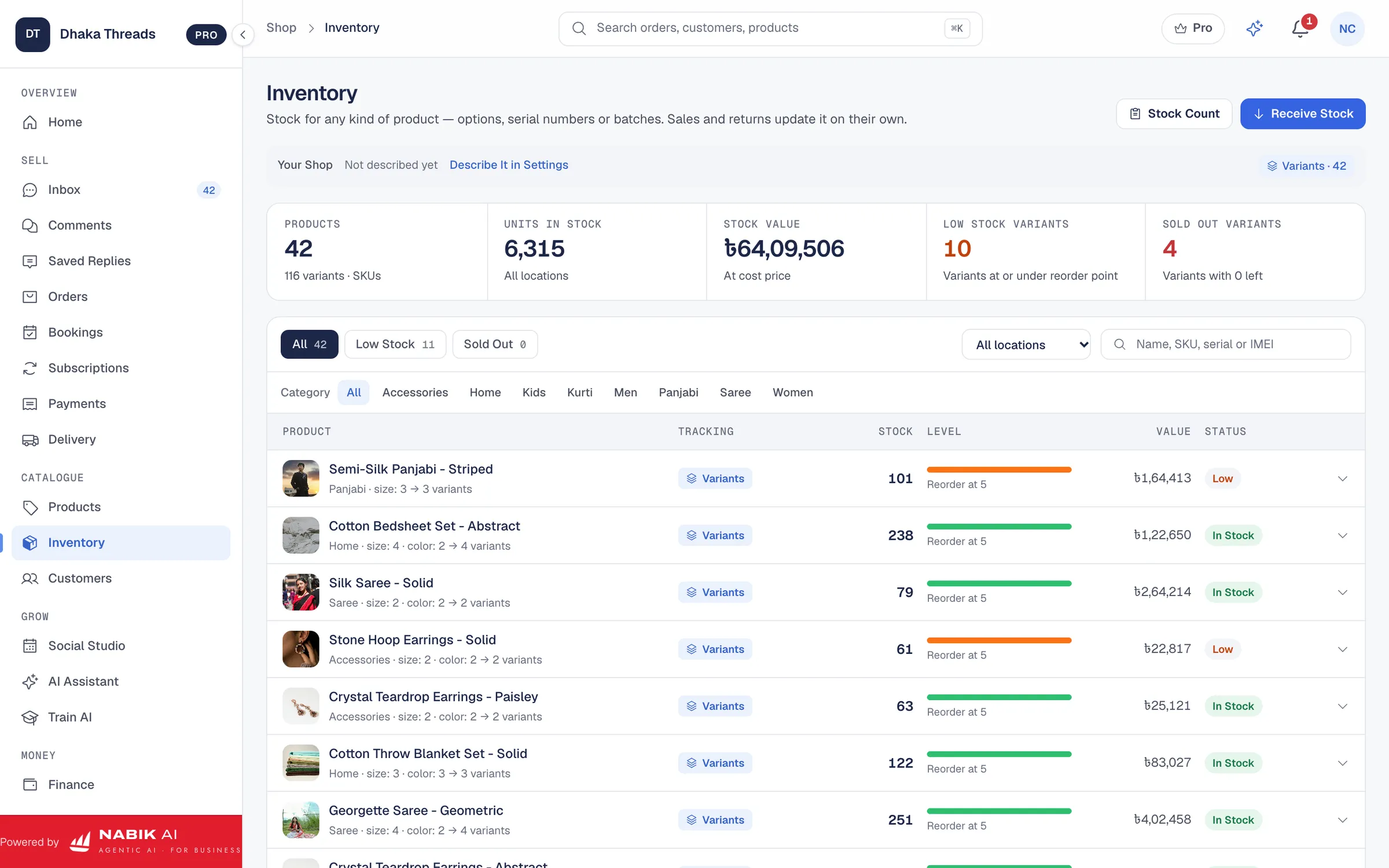
- Use your ecommerce software as the main source of truth for products and stock.
- Connect website orders into the same order list as your social orders.
- Clean product names, prices and variants before syncing to your website.
- Set clear, written rules for delivery and COD that match both website and social channels.
How Does Nabik AI Fit Into Ecommerce Software Vs Website Builder?
Nabik AI is ecommerce software made in Bangladesh for shops that sell on Facebook, Instagram, WhatsApp and their own websites. It is not a website builder by itself; instead it gives you the core systems you need before and around a website: AI chat, one inbox, orders, inventory, couriers, finance and bookings. You can later connect your WooCommerce, Shopify or Google Sheets store into it using online store integrations, so everything runs from one place.
On the operations side, Nabik AI gives you a single inbox for Messenger, Instagram, WhatsApp and Page comments through its social inbox. Its AI agents can reply in Bangla, Banglish or English based on your products, prices and policies, then take orders and hand over to you when needed. Orders go into the built‑in order system, where you can manage cash on delivery, update statuses and work with couriers; see what this includes in order management. Inventory features keep one stock pool across all channels, with low‑stock alerts via inventory management.
Because Nabik AI focuses on Bangladeshi shops, it understands realities like bKash and Nagad payments, COD couriers, Dhaka vs outside Dhaka delivery times and NBR VAT requirements. You can track finance and VAT, manage bookings for services like salons or clinics, and even send Bangla and Banglish AI customer replies without writing every line yourself. Pricing is in taka and starts with a free plan; the Pro plan is ৳999 per month and the Business plan is ৳3,780 per month, shown clearly on the pricing page.
If you later build a website with any popular builder, you can connect it into Nabik AI instead of starting from zero again. That way your AI agents know all your products whether the customer comes from Messenger, Instagram, WhatsApp or your website. So in the ecommerce software vs website builder decision, Nabik AI sits firmly on the ecommerce software side—but in a way that is ready to work with your website whenever you build it.
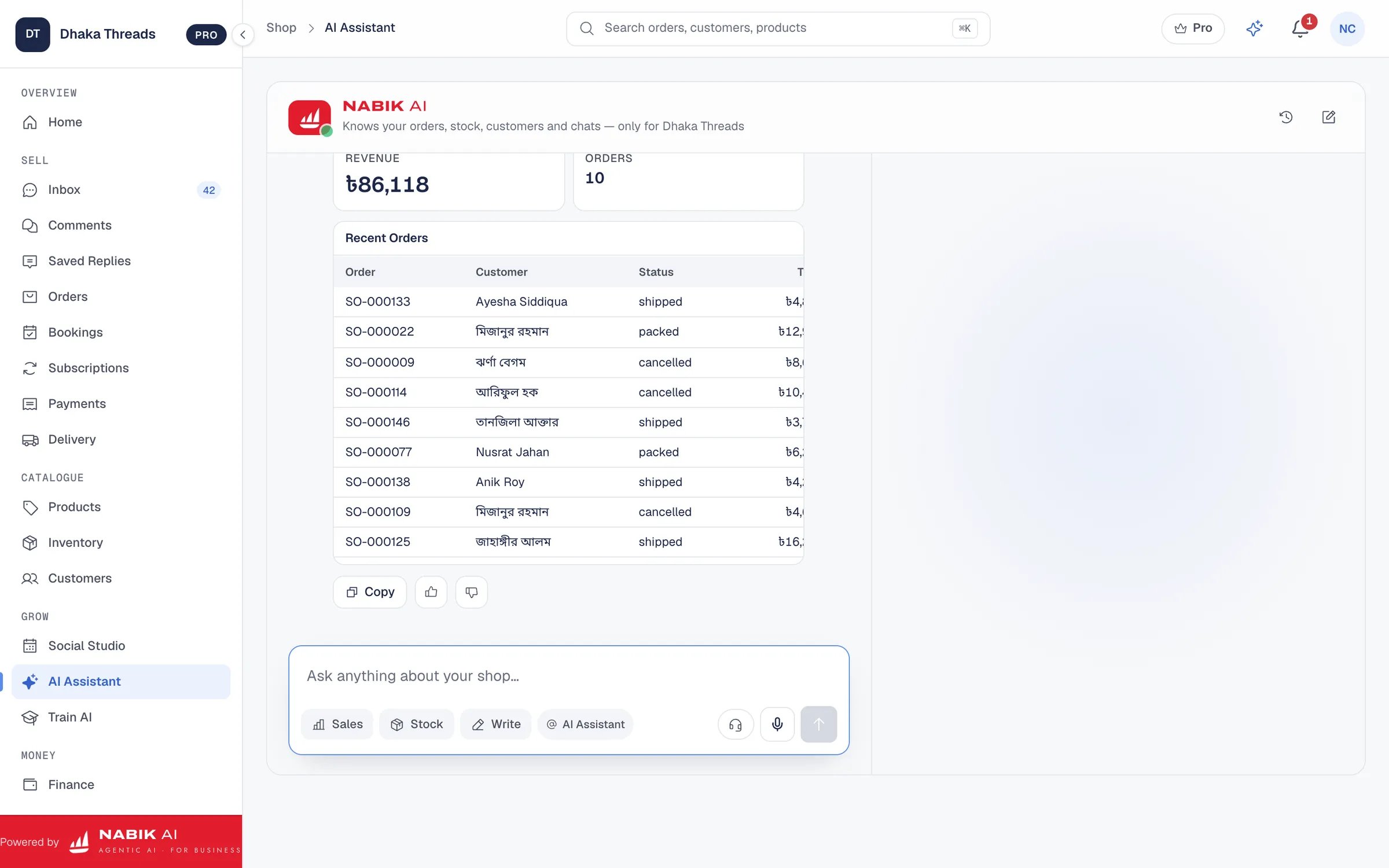
- Use Nabik AI as your main operations hub: inbox, orders, inventory and couriers.
- Let AI agents answer common questions in Bangla or Banglish and take orders from chats.
- Keep one stock count for Facebook, Instagram, WhatsApp and connected websites.
- Start on a free plan, upgrade when volume grows instead of spending early on design.
What Is Your 30-Day Action Plan From Here?
Knowing the theory is good, but you need a simple 30‑day plan. The goal is to reduce today’s mess and make a clear decision on ecommerce software and website builder, without wasting money. Use this as a checklist; you can adjust the pace if you are very busy, but try to keep the order.
In Week 1, map your current process honestly. How do orders come in (Messenger, comments, WhatsApp, phone calls)? Where do you write them? How do you choose courier and track COD returns? In Week 2, test one ecommerce software on real orders for at least 7 days. If Nabik AI is one option you try, use the free plan and connect your Facebook Page and WhatsApp, then let it handle some chats while you watch.
In Week 3, decide if your main pains are better now. Are replies faster? Are there fewer wrong parcels and lost orders? Is COD tracking clearer? If yes, keep the ecommerce software and stabilise your new process. Only in Week 4, if operations feel under control and cash flow allows, should you seriously plan a website builder. Check how it will integrate with your chosen ecommerce software before paying for domains and themes.
At the end of 30 days, you should have either: 1) Facebook/WhatsApp + ecommerce software and a clear process, or 2) The same plus a simple website plan that joins into that system. Either way, you avoid the classic trap of paying for a website that looks nice but sits empty while your inbox burns.
- Week 1: Map your current order and delivery process in detail.
- Week 2: Trial an ecommerce software on real orders, not demo data.
- Week 3: Fix issues and decide if operations are now under control.
- Week 4: Plan a website only if your main pains are solved and integration is clear.
Step 1: Day 1–3: Process Map
Draw your full journey from customer message to delivered parcel and returned COD, including every app and notebook you touch.
Step 2: Day 4–10: Software Trial
Connect your Facebook/WhatsApp to an ecommerce tool like Nabik AI and run a full week with it, adjusting as you go.
Step 3: Day 11–20: Clean Data
Standardise product names, prices and stock counts in the software so you trust its reports.
Step 4: Day 21–30: Website Decision
Decide if you will: A) pause website idea, B) build a basic site now and integrate, or C) schedule website for later when cash is stronger.
FAQ
Do I Really Need A Website To Sell Online In Bangladesh?
No, you can run a very good business only with Facebook, Instagram and WhatsApp, especially if you have proper ecommerce software for orders and delivery. A website helps with branding, trust and Google search, but it is not required on day one. For most new Bangladeshi shops, sorting out inbox, COD and couriers is more urgent than a website.
Can I Use Ecommerce Software Without Any Website?
Yes, and many Bangladeshi F‑commerce sellers do exactly that. Ecommerce software can manage your messages, orders, stock and couriers for Facebook, Instagram and WhatsApp only. You can add a website later and connect it into the same system so you do not start from zero again.
Which Is Cheaper In Bangladesh: Ecommerce Software Or A Website Builder?
For most small shops, ecommerce software with a sensible monthly fee is cheaper and more useful at the beginning. A website builder can look cheap, but once you add domain, hosting, SSL, custom design and sometimes developer help, the total can be higher. Also, wasted COD, returns and mistakes from not having order systems can cost more than any software fee.
Is A Facebook Page Enough, Or Should I Still Build A Website?
A Facebook Page is enough to start and can remain your main channel for a long time, especially if your buyers are mostly in Bangladesh and come from social media. You should think about a website when you want to look more professional, run serious ads or reach buyers who search on Google. Just make sure your operations are under control first with ecommerce software so the extra traffic does not break your system.
Will Ecommerce Software Help With NBR VAT And Accounts?
Some ecommerce software in Bangladesh, including platforms like Nabik AI, include basic finance and NBR VAT features to help you track sales and prepare Mushak 6.3. This can save time compared to manual Excel. However, for detailed tax matters, always confirm with NBR rules or a professional adviser.
What If I Already Built A Website But My Backend Is A Mess?
You do not need to throw the website away. First, bring in ecommerce software to organise inbox, orders, stock and couriers for your social channels. Then connect your existing website into that system so new website orders join the same flow, and slowly move away from any manual spreadsheets you used before.