For Bangladeshi online shops, a messenger chatbot Bangladesh used to mean a fixed question–answer bot on your Facebook Page. In 2026, most serious shops are shifting to AI agents that actually understand Bangla and Banglish, follow your own rules, and complete tasks like taking orders and checking stock.
This change is big because you no longer have to design long button menus and scripts. Instead, you teach the AI with your products, prices and policies, and it learns from live customer chats over time.
Key Takeaways
- Old Messenger chatbots were mainly button menus and fixed replies; AI agents in 2026 can understand real Bangla and Banglish conversations.
- AI agents connect to your stock, orders and couriers, so they can actually take orders instead of just collecting names and numbers.
- For most Bangladeshi shops, starting with an AI agent is now easier and often cheaper than building and maintaining a scripted Messenger bot.
- You should still control tone, rules, escalation to humans and COD verification to make AI safe for your Page.
- Tools like Nabik AI give Bangladeshi sellers an AI agent plus one inbox, orders, inventory and posting tools in one place.
What Really Changed From Old Messenger Chatbots To AI Agents?
Old-style Messenger chatbots were basically decision trees: if a customer pressed button A, they saw message B. In Bangladesh many Pages used them for quick menus like “Price list”, “Size chart”, “Order now”, but if someone typed their own question in Bangla, the bot often replied “Sorry, I didn’t understand.” In 2026, AI agents work differently: they read the full message in Bangla, Banglish or English, understand the intent, and decide what to do without you pre-writing every path.
The big change is flexibility. Instead of writing 50–200 canned replies, you load your product list, prices, delivery rules and FAQs into the AI once, then correct it when it makes a mistake. A modern agent can answer a question it has never seen before, as long as the answer is inside your data or policies. That means fewer dead-ends for customers and fewer “Inbox full of question marks” for you.
Another shift is that AI agents can act, not just reply. They can fill an order form, pick the right courier rule for Dhaka vs outside Dhaka, and ask follow-up questions like “Delivery Dhaka naki outside Dhaka?” on their own. This is where Messenger moves from just auto reply to real sales assistance for your Facebook, Instagram and WhatsApp customers.
- Old Messenger chatbot = fixed flows, buttons, keywords.
- Modern AI agent = understands free text, reasons, and decides next steps.
- AI agents learn from corrections while bots need manual re-scripting.
- AI agents can connect to stock, orders and couriers, not just send messages.
| Old Messenger Chatbot | Modern AI Agent (2026) | |
|---|---|---|
| Setup | Design flows, buttons, keywords by hand; can take weeks. | Upload products, prices and rules; adjust as it chats; usually days. |
| Language | Works best with fixed English/Banglish options. | Understands Bangla, Banglish and English free text questions. |
| New Questions | Often replies with “I don’t understand”; needs new script. | Can use your data + reasoning to reply even to new types of questions. |
| Taking Orders | Mostly collects name/phone; staff must process later. | Can create full order with address, delivery choice and payment rules. |
| Channels | Usually just Facebook Messenger. | Can work across Messenger, Instagram, WhatsApp and web chat. |
| Maintenance | Every offer change needs flow editing. | Update your data; AI adjusts behaviour automatically. |
| Best For | Very simple FAQs, low chat volume. | Shops with daily chats, changing offers, and COD orders. |
How Did This Change Daily Life For Bangladeshi Online Shops?
For Bangladeshi f-commerce sellers, the shift shows up first in your inbox stress. With old bots, a busy day of boosting might mean 200+ messages and you or your team manually answering “Color available?” and “Outside Dhaka delivery hoy?” until midnight. In 2026, shops using AI agents report that a large chunk of these repetitive chats never reach a human at all; they are answered correctly in Bangla before you even open Messenger.
Another visible change is multi-channel. Before, many shops had a simple Messenger bot, but WhatsApp and Instagram DMs were fully manual. Now one AI agent can answer a customer who writes “ami mirpur, friday delivery possible?” from Instagram the same way it would on Messenger or WhatsApp, using the same stock and delivery rules. That means fewer mistakes like promising “Tomorrow delivery” on one channel and “Within 3 days” on another.
Customer expectations also changed. People now message “Bro, XL ase? Cash on delivery charge koto Cumilla te?” and expect an instant, clear reply with exact courier charge and delivery time. Shops that still rely only on manual inbox work often reply late or miss DMs completely, losing orders to faster competitors. AI agents help you keep response times low even on Eid nights, public holidays and after viral reels.
Finally, this change affects your working hours. Instead of you logging in at 1am to clear messages, you can wake up to a queue of AI-prepared orders: name, phone, address, size, colour, payment method already confirmed. Your team’s job shifts from typing the same things all day to checking edge cases, following up payments and handling VIP customers.
- Less time spent on repetitive Q&A about price, size and delivery.
- Same quality of answers across Facebook, Instagram and WhatsApp.
- Higher customer expectations for instant Bangla replies with correct info.
- More of your time goes to fulfilment, marketing and product sourcing.

Messenger Chatbot Vs AI Agent: Which Is Right For Your Shop?
Not every Bangladeshi shop needs a complex AI setup, but in 2026 most shops outgrow basic Messenger bots quite fast. The right choice depends on your order volume, product complexity and how many channels you run. You can use this simple way to think about it: if you mainly need a mini menu on your Page, a traditional bot might still be enough; if you want the system to talk like a human staff and actually take orders, you need an AI agent.
A small boutique with 10–20 DMs per day, only inside Dhaka, and fixed prices might survive with a simple menu bot or even just quick replies. But once you cross 50–100 messages most days, with people coming from boosted posts, reels and WhatsApp forwards, manual or button-based systems become tiring and error-prone. If you also have variations (size, colour, flavour, bundle offers) and different delivery rules inside vs outside Dhaka, rule-based bots become very complex to maintain.
Here is a quick way to decide today:
If you already use a Messenger bot and feel scared to touch its flows, that is a sign it’s too complex. If you do frequent sales (11.11, 12.12, Pahela Baishakh, winter collection) and change offers regularly, AI agents will adapt faster because you only update products and policies, not every button. And if you run multiple Pages or shops, one AI layer across all of them is usually simpler than separate bots per Page.
- Under 20 messages/day, one channel, simple catalog → quick replies or very simple bot can work.
- 20–100 messages/day, multiple questions per customer → AI agent starts to save time and mistakes.
- 100+ messages/day, multiple channels, sizes/colours/locations → AI agent is usually a must.
- If you hate updating your current bot but keep delaying it, consider switching to AI instead of rebuilding flows.
How Do Facebook Messenger AI Agents Actually Work In 2026?
An AI agent for Facebook Messenger in 2026 is more than a chatbot script: it is a system that reads each message, looks at your shop data, decides what the customer needs, and then takes actions. First, it understands the text: “boss, 2 ta black L lagbe, Cumilla delivery, bkash dibo” is recognised as an order request for a specific variant, outside Dhaka, with prepayment. Then it checks your product list, stock and delivery rules before replying.
Second, the agent follows your policies instead of hard-coded flows. You define things like minimum order amount, COD availability, advance payment rules for outside Dhaka, courier options and return rules. When a customer asks “return possible jodi size na mile?”, the agent pulls the answer from your policy, not from a single fixed FAQ line. If you later update the policy, the agent uses the new one automatically.
Third, a proper agent connects across tools: stock, orders, couriers, even your website store. That means it can do things like creating an order, setting the right status (e.g., Pending, Confirmed, Shipped), and triggering courier booking once you approve. If you also sell on WooCommerce or Shopify, an AI agent tied to an online store integration can use the same inventory pool for chat orders and website orders.
Finally, AI agents improve over time. When you or your staff edit a wrong reply or correct a wrong size, the system learns from it so next time it answers correctly. Guides like training the AI on your products and prices are now part of normal shop setup, just like adding an address or logo was in older days.
- Understands intent in Bangla/Banglish messages, not just keywords.
- Uses your live data: products, stock, delivery rules, return policy.
- Can take actions: create orders, help with courier steps, update statuses.
- Learns from corrections instead of needing full flow rebuilds.
What Should You Check Before Switching From A Messenger Chatbot?
Moving from a classic Messenger bot to an AI agent is not only a technical shift; it is also about control, safety and cost. Start with language: test if the AI can handle real customer-style Bangla and Banglish, not just polished textbook lines. Try messages like “vai, last price koto?”, “COD outside Dhaka possible?” and “same day dorkar, emergency” and see if the agent replies clearly and politely.
Next, look at safety and control. You should be able to set boundaries like “never give personal numbers”, “never promise delivery faster than X days outside Dhaka”, and “always ask for full address before confirming COD”. Also check how easily you can pause or override the AI, and how chats are handed over to humans when the AI is unsure. For more depth you can read about AI chatbot safety on a Facebook Page.
Third, consider costs and workload. Old bots often needed a developer or agency every time you changed something, which could be slow and expensive. Modern AI tools usually charge a monthly fee plus AI usage, but you save manual labour and script maintenance. Articles like what an AI chatbot costs in Bangladesh can help you estimate this.
Finally, think about COD and fake orders. An AI agent should follow your verification steps: confirming phone, landmark, delivery charge acceptance, and maybe OTP or bKash advance for risky locations. Combine it with your own process improvements from guides like reducing fake COD orders and returns to protect your margins.
- Test in real Bangla/Banglish, not only English demo messages.
- Set strict rules on delivery promises, refunds and personal data.
- Check how handover to human works when AI is not confident.
- Review pricing versus your current staff time and developer costs.
- Design a clear COD verification flow before going fully automated.
How Does Nabik AI Help With Messenger Chatbots And AI Agents?
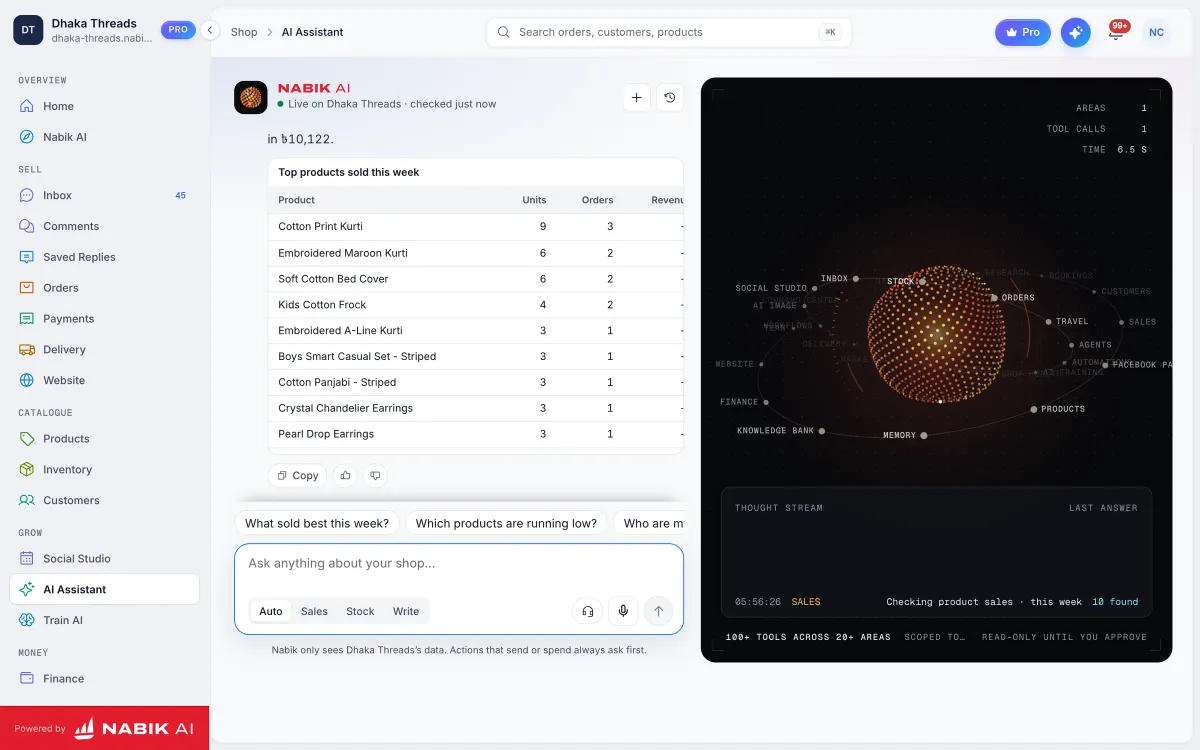
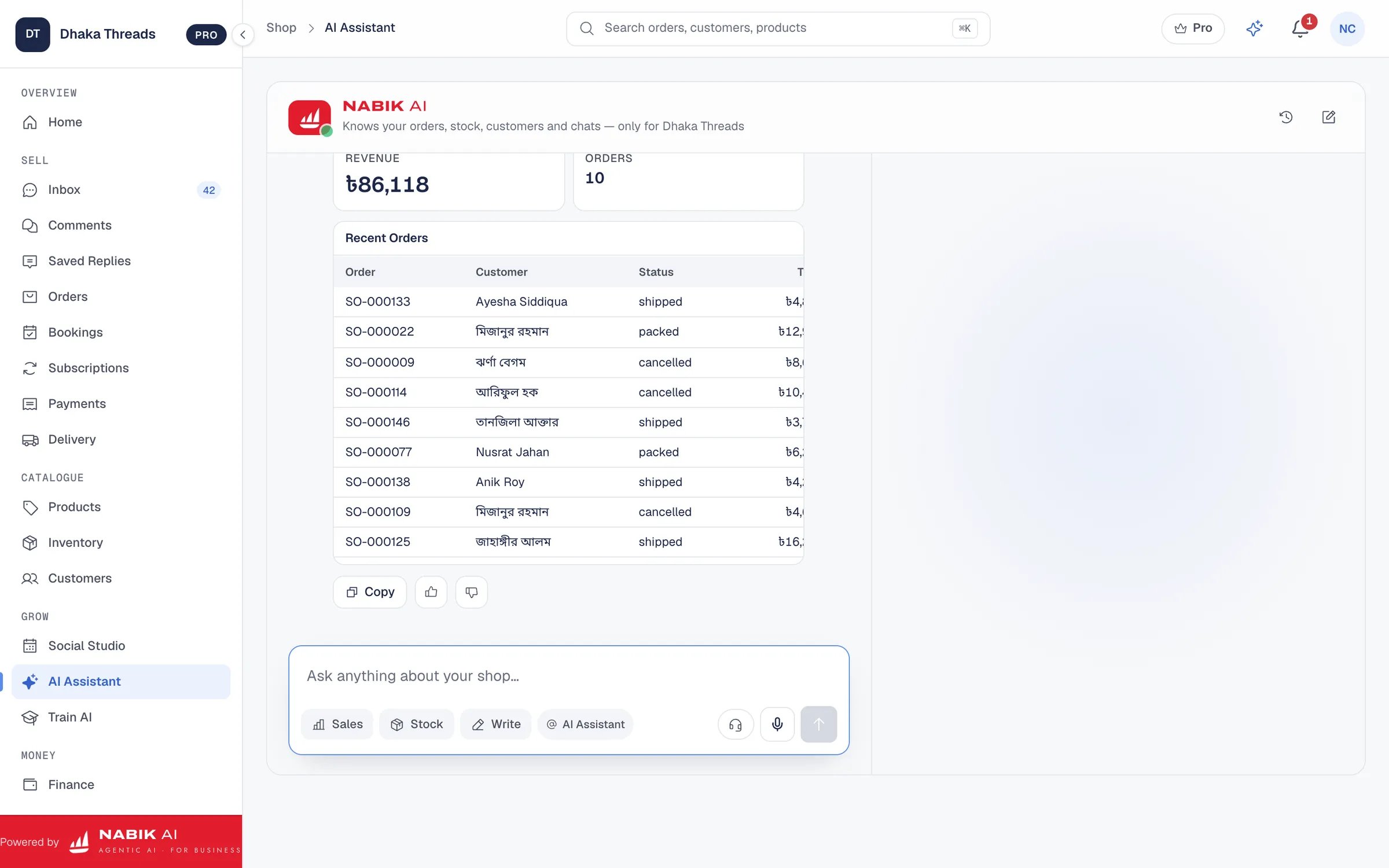
Nabik AI is web software made in Bangladesh for shops and Pages that sell on Facebook, Instagram, WhatsApp and their own websites. Its AI agents act as your smart Messenger, Instagram and WhatsApp assistant: they answer in Bangla, Banglish or English from your own products, prices and policies, take orders, and hand over to a person when needed. You teach Nabik AI simply by chatting with it, and it learns from every correction, which fits the new AI agent style of 2026.
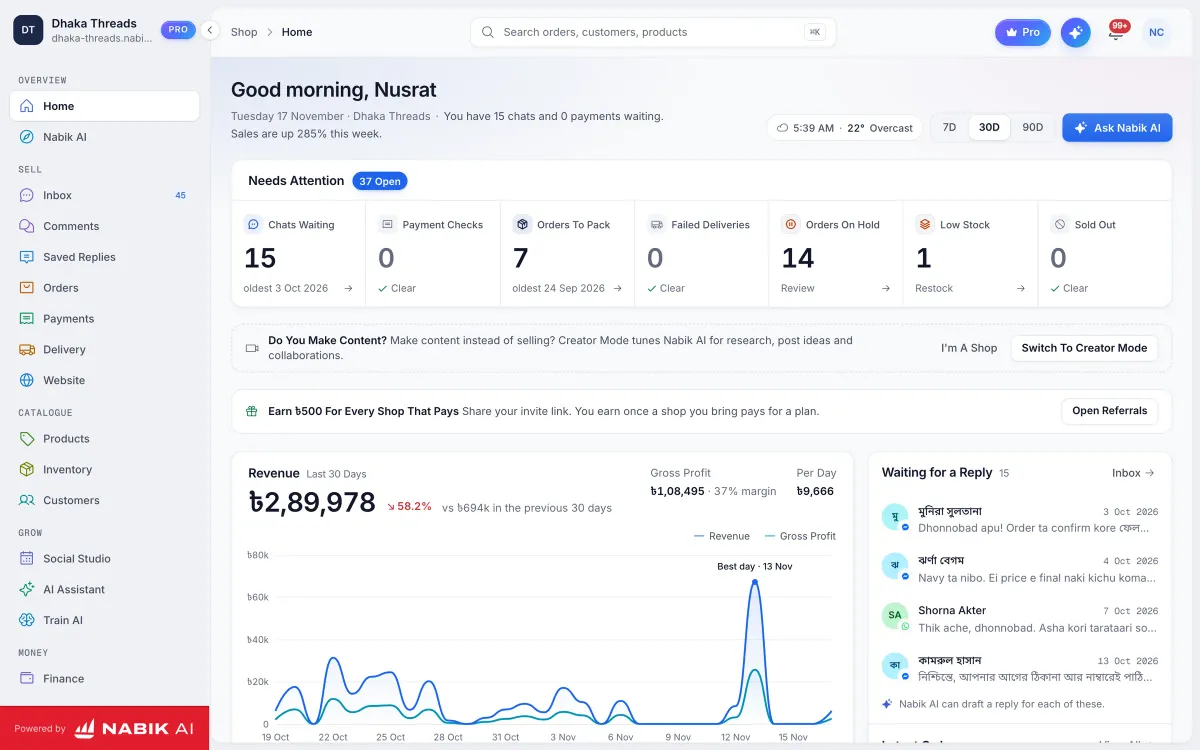
Around the AI agent, Nabik AI gives you one inbox for Messenger, WhatsApp, Instagram and Page comments, so you see all chats in one place instead of jumping between apps. From the same system you can manage Facebook AI chatbot replies, scheduled posts and AI content with the social media scheduler, and chat-based order management including cash on delivery and courier booking. Inventory stays in sync across channels through inventory management, so when the AI confirms “last XL piece” it is using the same stock pool as your website.
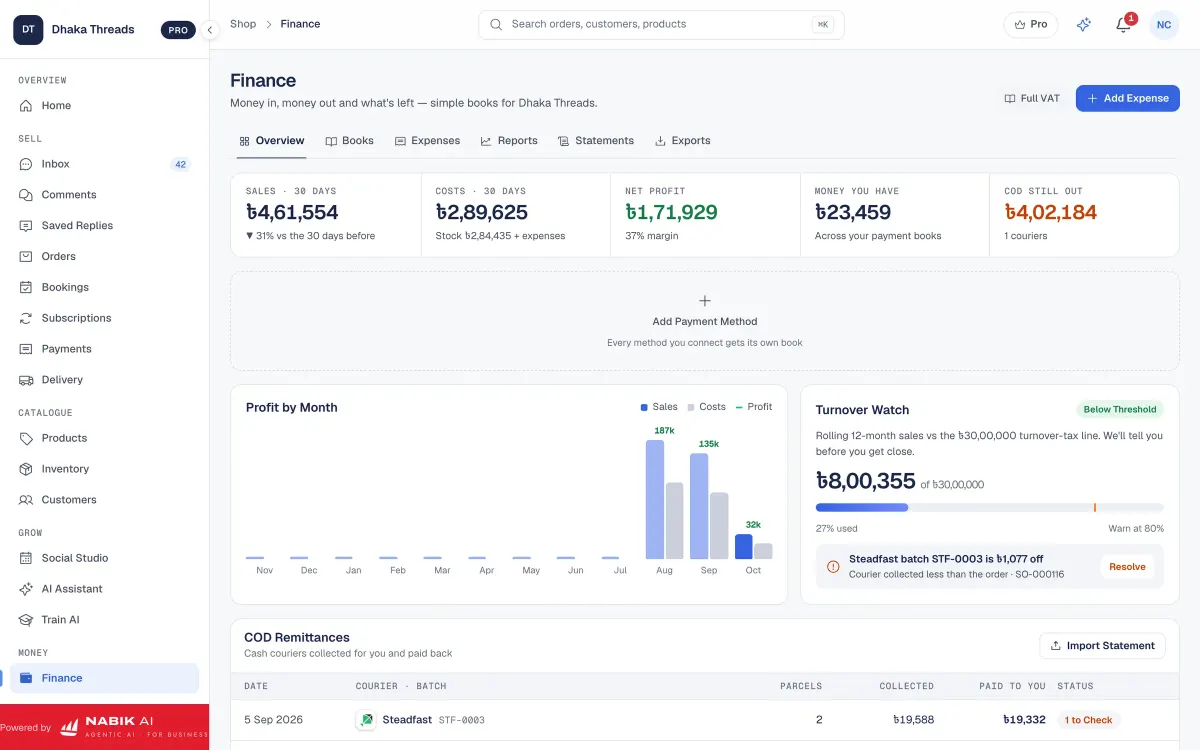
Nabik AI runs in the browser on desktop and phone, with plans in taka and a free start. The Pro plan is ৳999 per month and the Business plan is ৳3,780 per month; AI usage runs on top-up credits you can explore at /ai-credits. Because it also has finance and NBR VAT tools via accounting and VAT features, many Bangladeshi sellers replace 3–4 separate tools with one system. You can see all plan options at the /pricing page and sign up at https://app.nabik.ai/signup.
If you already run a basic Messenger bot, you do not need to turn it off on day one. You can connect your Page to Nabik AI at the unified social inbox, let the AI agent handle most chats, and keep some simple auto replies from your old bot if they add value. Over time, as you get confident, you can move more of your flows into the AI layer and simplify your tech stack.
- AI agents that reply in Bangla, Banglish or English using your own catalog and policies.
- One inbox for Messenger, WhatsApp, Instagram and comments, plus AI chatbot features.
- Orders, COD, courier booking, stock and VAT-friendly finance in the same system.
- Browser-based app with Bangladeshi pricing and a free starting plan.
What Simple Action Plan Should You Follow For 2026?
To adapt to the Messenger chatbot vs AI agent shift in 2026, give yourself a 30-day plan. Week 1: audit your current chats—export or scroll through recent messages and list the 20 most common questions (price, size, colour, delivery Dhaka/outside Dhaka, payment methods like bKash/Nagad, return). Decide which of these you are happy for an AI to answer and where you still want a human to step in (high-value B2B orders, medical/clinic decisions, very angry customers).
Week 2: clean your data. Put your products, variants and prices into one sheet, along with courier rules and payment policies. Make sure you have clear text for things like “delivery inside Dhaka”, “outside Dhaka”, “prepayment via bKash/Nagad/card”, “return/replace rules”. This simple work makes any AI agent—including Nabik AI—much more reliable and reduces weird or half-correct answers.
Week 3: test one AI agent in real life but under supervision. Connect it to your Facebook Page and maybe WhatsApp, but keep notifications on so you see every conversation at first. Correct wrong replies, add missing information, and fine-tune tone so it matches your brand—“vai/apa” or more formal, depending on your audience. Use this week to build trust with the system.
Week 4: scale carefully. Let the AI handle more hours of the day (nights, weekends, busy campaign days) and more question types. Start using it to create draft orders directly from chat so your staff only need to verify and pack. Review results at the end of the month: response times, order count, fake order rate, staff hours saved, and decide how far you want to lean into AI for the rest of 2026.
- Audit your inbox and separate repeat questions from edge cases.
- Organise products, prices, courier rules and policies in one clean place.
- Run a supervised AI trial before fully switching from your old bot.
- Gradually increase AI responsibility while tracking key numbers like orders and returns.
Step 1: List Your Top 20 Customer Questions
Open your recent Messenger, Instagram and WhatsApp chats and write down the questions you see again and again—this becomes your AI’s core script.
Step 2: Prepare Clean Shop Data
Create a simple spreadsheet with product names, variants, prices, stock status, delivery charges and COD rules; keep it updated weekly.
Step 3: Run A Supervised AI Pilot
Connect an AI agent to your Page, let it answer common questions, and correct its mistakes daily for at least 7 days.
Step 4: Review And Decide Next Steps
Compare time saved, orders taken and customer feedback, then choose whether to replace your old bot fully or keep a hybrid setup.
FAQ
Is a classic Messenger chatbot still useful in Bangladesh in 2026?
Yes, a simple Messenger chatbot can still help with very basic tasks like showing a menu, giving your phone number or sending a location. But for shops with daily chats, sizes/colours and COD orders, AI agents now handle real conversations and orders much better than button-based bots.
Will an AI agent replace my sales staff?
In most Bangladeshi shops, AI agents reduce repetitive typing, not people. Your team still handles exceptions, VIP customers, complex queries and after-sales service, while the AI takes care of routine price, stock and delivery questions and prepares orders for them.
Can AI agents handle Bangla and Banglish properly?
Modern agents like the ones used in Nabik AI are built to understand Bangla, Banglish and English mixed in one conversation. You should still test them with real-life messages like “XL ase? Cumilla delivery charge koto?” to check quality before going fully live.
Is it risky to let an AI agent confirm COD orders?
It can be risky if you do not set clear rules and verification steps. You should define how the AI confirms addresses, explains delivery charges, and when it should ask for advance bKash/Nagad; combining AI with a solid COD policy usually gives the best results.
How much does an AI agent for Facebook Messenger cost in Bangladesh?
Costs vary by tool and usage, but generally you pay a monthly fee plus AI usage based on conversations. With Nabik AI, plans start at ৳999 per month for Pro and ৳3,780 per month for Business, with AI credits available as separate top-ups described at the /ai-credits page.